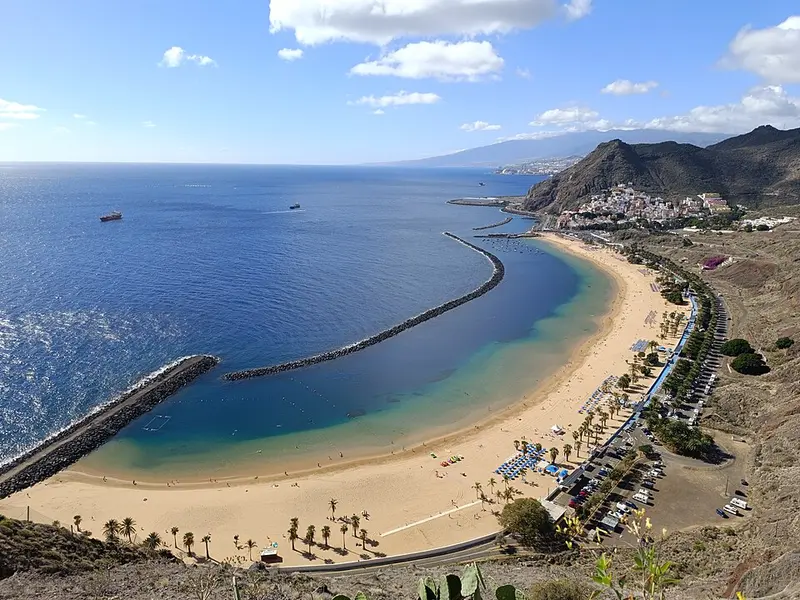

Before travelling to Tenerife, know five things: there are two airports and the island is bigger than it looks, the Canaries run an hour behind mainland Spain, the Teide summit has to be booked and paid for, the Atlantic is not the Mediterranean, and the sun burns even when it's cloudy.
Two airports and an island bigger than it looks
Tenerife has two airports: Tenerife North (TFN), in La Laguna, with almost all inter-island flights and many from mainland Spain, and Tenerife South (TFS), in Granadilla, with most international ones. They're about 60 kilometres apart by motorway. Pick the one closest to where you're staying: landing in the north to stay in Costa Adeje means starting your holiday with an hour in the car.
It's the largest of the Canary Islands, 2,034 km², with a 3,715-metre mountain in the middle. Distances are deceptive: from the south to Anaga or Teno takes over an hour, and the mountain roads are all bends.
Car or guagua
To see the island, rent a car. Teide, Anaga, Teno and the northern towns are far easier by car, and that's what almost everyone does.
The guagua (that's what we call the bus) is run by TITSA and goes almost everywhere, with routes linking the airports to the south, Santa Cruz and Puerto de la Cruz. You can pay on board with a bank card or with the Ten+ card. Between Santa Cruz and La Laguna there's a tram.
The northern motorway (TF-5) jams between La Laguna and Santa Cruz at weekday rush hours, and the southern one (TF-1) on Sunday afternoons, with everyone driving back from the beach.
The Canaries are an hour behind
The Canary Islands keep the same time as London and Lisbon: one hour behind mainland Spain and most of Europe. If you're coming from the UK or Ireland, nothing changes; from anywhere else in Europe, set your watch back an hour and check which time zone your bookings are in.
Teide needs booking (and the summit costs money)
You can drive up into Teide National Park without asking anyone, for now. What needs booking is the summit: the last stretch, the Telesforo Bravo trail, from La Rambleta, where the cable car drops you, to the 3,715-metre peak. As of October 2026:
- You book it on the island council's website, Tenerife ON, in time slots, with your name and ID or passport.
- Since January 2026 it costs 15 euros for anyone who doesn't live in the Canary Islands and 6 for residents of other islands. It's free for Tenerife residents and children under 14.
- A cable car ticket does not include the summit permit.
- Walking up via Montaña Blanca to La Rambleta also costs money for non-Canarian residents: 6 euros on weekdays and 10 at weekends and on public holidays.
- In October 2026 the council announced daily quotas and free booking for three more trails in the park: Pico Viejo (PNT 9), Los Regatones Negros (PNT 23) and Chafarí (PNT 28). Going in without a booking can mean a fine of up to 600 euros.
- It's also preparing car-park booking, an eco-tax for visitors and, from 2027, shuttle buses from the coast.
The rules are changing fast, so check tenerifeon.es before you go up. And wrap up. It's properly cold up there: where the cable car stops, at 3,555 metres, it drops below zero in winter, there can be snow and ice, and you feel the altitude (dizziness, headaches). The cable car stops running in strong wind.
Masca, Teno and Barranco del Infierno have rules too
- Masca gorge: the trail is downhill only, booked on its official website, in morning slots with limited places. To walk it, you ride TITSA bus 355 up to the village from Santiago del Teide, and at the bottom you return by boat to Los Gigantes, paid separately. No children under 8, and for anyone who doesn't live in Tenerife it costs from around 40 euros.
- Punta de Teno: the lighthouse road (TF-445) is closed to private cars much of the time, and you get there on TITSA bus 369 from Buenavista del Norte. Roadworks and storms change things, so check before you go.
- Barranco del Infierno, in Adeje: compulsory online booking, 16 euros for non-Canarian residents and entry in the morning only (barrancodelinfierno.es).
Conditions change with roadworks, rockfalls and weather warnings: check each official website before you go.
The sea is the Atlantic
This is not the Mediterranean: there are waves, currents and swell, and a swell can arrive on a perfect sunny day because a storm thousands of kilometres away sent it. The north gets the worst of it, especially in winter. What you need to know:
- The flags: green, good conditions; yellow, caution; red, no swimming.
- No flag, no lifeguard: outside their hours, out of season or in a cove, nobody is watching. It's your call there, and the sea gives no warning.
- The warnings: when the Canary Islands Government issues a pre-alert or alert for coastal hazards, the sea is not for heroes. In 2025, 69 people drowned in the Canary Islands, and 32 of them while one of those warnings was in force (Canarias, 1.500 km de Costa association, via RTVC).
- Charcos, harbour walls and rocks: every year, big waves sweep away people who were only watching. If waves are breaking over the top, get out.
- The water ranges from about 19 degrees at the end of winter to about 24 at the end of summer: properly refreshing.
PlayaYa! shows the official warnings in force for every beach, the day's flag where the lifeguards publish it and whether the health authority has banned swimming. Even so, look at the water yourself: no app can see the waves for you.
The sun is stronger than it looks
Tenerife is on the same latitude as the Sahara: the midday sun is strong all year round, in winter too and through cloud too. The breeze hides it, and on day one half the plane gets burnt. Proper sun cream, a hat and some sense about the middle of the day.
Pack flip-flops and a jacket
In a single day you can go from 25 degrees on the beach to real cold at the top of Teide, and from southern sunshine to northern drizzle in half an hour's drive. Bring a proper jacket if you're going up, and closed shoes for the trails. To understand why it changes so much, read north or south.
IGIC, shopping and customs on the way back
There's no VAT in the Canary Islands: there's IGIC, with a standard rate of 7%. That's why tobacco, alcohol and some perfumes are cheaper. But the Canaries are outside the EU VAT area, so flying back to mainland Spain, the Balearics or another EU country there are limits, as if you were arriving from outside the EU:
- 200 cigarettes, or 100 cigarillos, 50 cigars or 250 grams of tobacco.
- 1 litre of spirits over 22%, or 2 litres under that; plus 4 litres of wine and 16 of beer.
- Other goods up to 430 euros per person by air or sea (150 for under-15s).
- Under-17s get no tobacco or alcohol allowance.
Source: Spanish Tax Agency. Travelling to the UK or elsewhere outside the EU, your own country's allowances apply.
Look after the island
- Take nothing from Teide National Park, neither stones nor plants, and don't stack stones either.
- A closed beach is closed. Benijo, in Anaga, has been shut for years because of rockfalls: going down can earn you a fine and, worse, a rock on the head.
- Park where you're allowed to: on mountain roads, a badly parked car blocks the way for an ambulance.
- Whales and dolphins only with licensed boats: pilot whales and bottlenose dolphins live year-round between Tenerife and La Gomera, in a protected marine area.
- People live here: say hello, turn the music down on the beach and leave the place as you found it.
If something happens: 112
The emergency number is 112, which also works in English. If you're coming from the EU, bring your European Health Insurance Card. And for everything that will surprise you here, which is quite a lot, read what surprises visitors to the Canaries.

PlayaYa! is a free app for Android and iOS, built by a Canarian, that scores every beach, charco and natural pool in the Canary Islands from 0 to 100, hour by hour: 48 hours ahead, and 72 if you ask.
Which beach? Ask PlayaYa!