
The first thing that surprises visitors to the Canary Islands is that people talk, eat and read the sky differently here: the bus is the guagua, potatoes are papas, everyone says ustedes instead of vosotros, coffee comes as leche y leche, and the weather has names of its own, like calima or panza de burro.
How people talk: guagua, papas and ustedes
Canarian Spanish sounds closer to Andalusia, Cuba or Venezuela than to Madrid: the 'z' is said like an 's', the 's' is softened and nobody says vosotros. It's ustedes for everyone here, friends included. A pocket dictionary:
- Guagua: the bus.
- Papa: a potato. And millo, sweetcorn.
- Cholas: flip-flops.
- Cotufas: popcorn.
- Baifo: a young goat. Machango: someone clowning around.
- Chacho or chacha: what you say when something surprises you, good or bad. And ¡ños! is the same, louder.
- Fisco: a tiny bit. «Ponme un fisco de mojo», just a bit of mojo.
- Mi niño, mi niña: what anyone will call you, whatever your age.
What to eat: papas arrugadas, mojo and gofio
The essentials are cheap and served in any bar:
- Papas arrugadas con mojo: small potatoes boiled in very salty water until the skin wrinkles, with two sauces: red mojo (mojo picón), with dried pepper, and green mojo, with coriander or parsley.
- Gofio: toasted grain flour, the base of Canarian food since the Guanches. It goes into escaldón (stirred into broth), kneaded into a dough, into the breakfast milk or into desserts.
- Goat's cheese, fresh, cured or smoked, and grilled with mojo.
- Fish: vieja (parrotfish), cherne (wreckfish) or sama (sea bream), grilled or boiled, with papas and mojo.
- Carne fiesta (marinated pork) and conejo en salmorejo (rabbit in a garlic and pepper sauce), the meat classics.
- Desserts: bienmesabe (almond, sugar and egg), quesillo (a Canarian flan) and frangollo.
And the Canarian banana, the small speckled one: it tastes of more than the ones back home, as you'll find out. Tenerife also has five wine denominations of origin, from Tacoronte-Acentejo to Abona, with listán negro and malvasía as its flagship grapes.
Guachinches: the house wine, in the family's house
A guachinche is a family winery that opens for a few weeks or months a year to sell its own wine with home cooking: papas, pork, ribs with potatoes and corn on the cob, chickpea stew. Simple tables, a short menu and low prices. They're mostly in the north of Tenerife: Tacoronte, El Sauzal, La Matanza, La Victoria and La Orotava.
Some restaurants call themselves guachinches and aren't. The real one sells the wine it makes: ask whose wine it is, and if the answer is a family name, you're in the right place.
Coffee is ordered differently
- Leche y leche: coffee with condensed milk and regular milk.
- Barraquito: Tenerife's own. Condensed milk, coffee, Licor 43, milk, cinnamon and lemon peel, in layers, in a glass. There's an alcohol-free version too.
- Cortado natural: coffee with a dash of milk, no condensed milk.
An hour behind
The Canaries keep London time: one hour behind mainland Spain. «Una hora menos en Canarias» (one hour less in the Canaries) is said on the radio every hour and is practically a catchphrase. The practical side is in what to know before you go.
The weather has names of its own
- Alisio: the north-east trade wind that blows almost all year and brings the clouds to the north.
- Mar de nubes (sea of clouds): the cloud layer the trade wind leaves halfway up the mountain. From Teide it looks like a white sea.
- Panza de burro (donkey's belly): that same layer when it settles over La Laguna or the valley, low and grey.
- Calima: Saharan dust in the air, on an east wind. A yellowish sky, heat and poor visibility.
- Tiempo sur: a warm, gusty south wind that sometimes brings rain to the south of the island, the opposite of the usual.
Which one your beach gets today is explained in north or south, and the PlayaYa! score looks at it hour by hour.
Black sand, golden sand and charcos
Tenerife's natural sand is black and volcanic: at midday it's as hot as a griddle, so flip-flops always. Many of the golden beaches in the south are man-made, and Las Teresitas, in Santa Cruz, was built in the 1970s with sand brought from the Sahara.
And the most Canarian place to swim isn't a beach: it's a charco, a natural pool in the volcanic rock that the sea fills. Look at the sea before you get in: with a swell running, the waves come over the top.
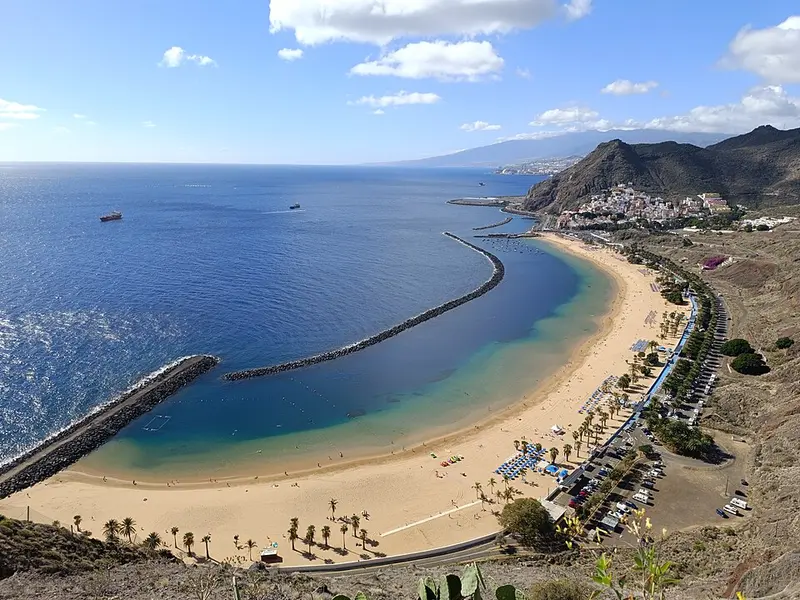 97
Playa de Las Teresitas
Santa Cruz
22-25 °C6-11 km/h0.6 mWhole window
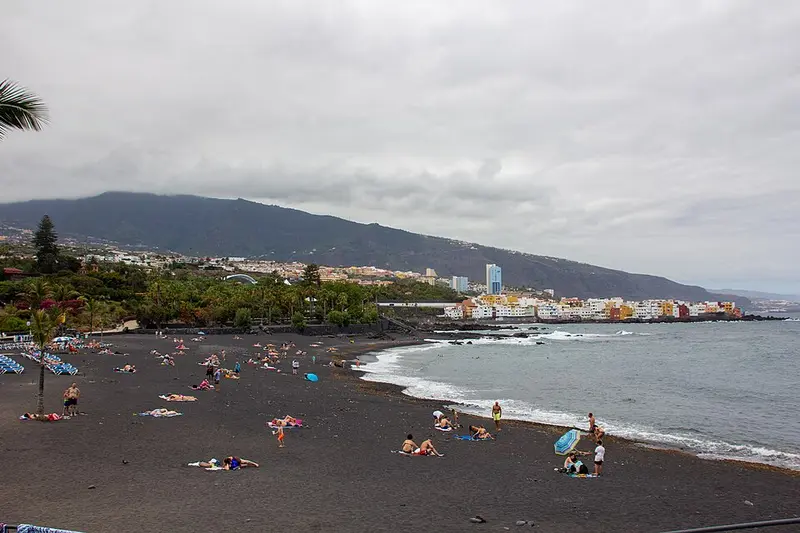 96
Playa Jardín
Puerto de la Cruz
23-25 °C4-7 km/h1.0 mWhole window
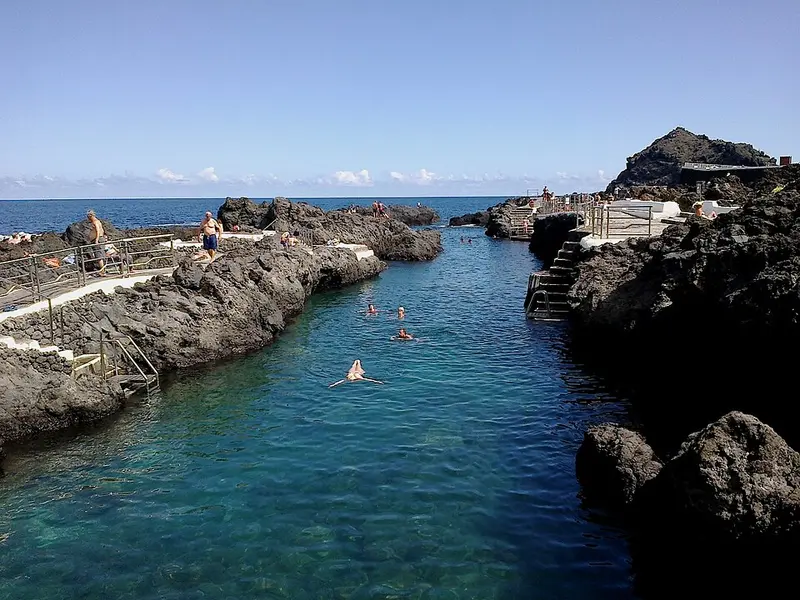 95
El Caletón (Garachico)
Garachico · tide pool
21-24 °C5-11 km/h1.1 mWhole window
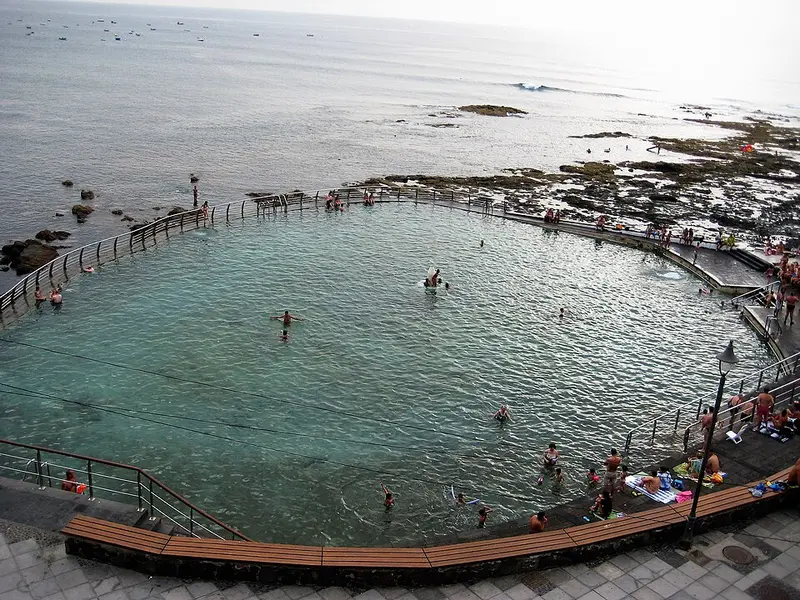 97
Piscina Natural Punta Hidalgo
La Laguna · natural pool
21-25 °C6-10 km/h1.1 mWhole window
Fiestas: carnival, flower carpets and wooden boards
- Santa Cruz Carnival (February): one of the biggest in the world and a Festival of International Tourist Interest. People dress up for real and the streets don't sleep.
- Corpus Christi in La Orotava (May or June): flower carpets in the streets and a huge tapestry in the town hall square, made from coloured volcanic earth from Teide.
- Romerías (spring to autumn): ox carts, traditional dress, music and food handed out for free. San Benito in La Laguna and San Isidro in La Orotava are among the biggest.
- Canary Islands Day, 30 May: a public holiday on every island.
- Virgin of Candelaria (14 and 15 August): thousands of people walk through the night to the basilica in Candelaria, home of the patron saint of the Canaries.
- San Andrés (29 and 30 November): the wineries open and the new wine is tasted with roast chestnuts. In Icod de los Vinos people slide down the steep streets on wooden boards, and in Puerto de la Cruz they drag rattling pots and pans through town.
And a few extras
- The Guanches were Tenerife's first inhabitants. In Candelaria, facing the sea, stand the statues of their nine menceyes, the island's kings.
- IGIC, not VAT: the standard rate is 7%, which is why tobacco and alcohol are cheaper. Mind the limits when you fly home.
- Lucha canaria (Canarian wrestling) is the local sport: two wrestlers in a sand circle, and whoever throws the other to the ground wins.
- Silbo gomero, the whistled language of La Gomera, the island across the water, is on UNESCO's list of Intangible Cultural Heritage.
And if you've come to see the island, read things to do in Tenerife, area by area.

PlayaYa! is a free app for Android and iOS, built by a Canarian, that scores every beach, charco and natural pool in the Canary Islands from 0 to 100, hour by hour: 48 hours ahead, and 72 if you ask.
Which beach? Ask PlayaYa!